Domain to Decision
Hand it a company's web domain — nothing else. It researches the company from public sources, scores how promising a sales lead it is, drafts a first outreach message, and decides how to route it. Automatically, at roughly a fifth of a cent per lead, with every step auditable afterwards.
The hard part was never asking a model for a score — it's making that one call reliable, deduplicated, cost-bounded and traceable in production. What follows is a walkthrough of the engineering around the call, not the call itself.
One request in, one enriched decision out
A public webhook takes {"domain": "stripe.com"}. Enrichment runs from free public sources (DNS, RDAP, a site scrape, a tech fingerprint), the profile is scored by an LLM behind a provider-agnostic interface, the model's JSON is validated against a schema, and the cost of the call is booked. Below is a real response from the deployed service.
// real response, trimmed
{
  "domain": "stripe.com",
  "tier": "cold",
  "score": {
    "score": 15, "confidence": 0.85,
    "reasoning": "Established fintech; a vendor/platform, not a
                  prospect for typical B2B services...",
    "draft_message": "Hi Stripe team — we noticed your infrastructure..."
  },
  "profile": {
    "resolved": true,
    "technologies": ["Next.js", "React", "nginx"],
    "sources_ok": ["dns","whois","scrape","tech_fingerprint"],
    "sources_failed": []
  },
  "usage": { "model": "anthropic/claude-haiku-4.5",
             "input_tokens": 1202, "output_tokens": 166,
             "cost_usd": 0.002032 }
}
The confidence is tied to how complete the profile was, so a thin profile yields a low-confidence score rather than a confident hallucination.
The draft_message is deliberately a starting point, not the headline: with a domain as the only input and a cheap, fast model chosen for cost, it reads generic by design. Personalizing against a specific offer or ICP is an extension point — a line drawn on purpose, not a limit hit by accident.
A hard boundary: orchestration vs domain
n8n is the visible skeleton; it never touches enrichment, prompts, or scoring. It deduplicates, calls one HTTP endpoint, retries transport failures, routes on a tier string, and dead-letters on exhaustion. FastAPI owns everything domain-specific and stays a pure function of its input — which is what makes the core reusable outside this workflow.
The decisions a reviewer looks for
Race-safe idempotency, one statement
Key acquisition is a single INSERT … ON CONFLICT DO UPDATE … WHERE status='failed' RETURNING. Two concurrent submissions of the same key cannot both proceed.
A prior failed run is retryable; a completed one is served from cache and never re-routed — so a resubmission never re-fires a side effect or re-spends.
Two retry layers, deliberately different
n8n retries transport failures (network / 5xx) with backoff. FastAPI runs a separate schema-repair loop that re-prompts the model with the validation error.
A network retry re-sends an identical request; a repair retry changes the prompt. Merging them would waste spend or leak domain logic into n8n.
Cost measured, not estimated
Every LLM attempt is booked the moment it returns — repaired and failed ones included — so a model looping on garbage can't blind the daily ceiling.
Two real providers sit behind one interface; the OpenRouter path reads back the actual USD charge, so cost-per-lead is a measured number.
Validated, not trusted
The model's JSON is parsed against a Pydantic schema. Invalid output is repaired within a bound or surfaced as a typed 422 — malformed data never reaches the caller.
The same schema is reusable by an eval harness that replays dead-lettered inputs.
Every exit path, verified live
Not a local mock run — a public n8n instance calling a deployed FastAPI service, scoring with a real model, backed by real Postgres.
| Situation | Status | What comes back | Verified |
|---|---|---|---|
| Bad or missing auth token | 403 | rejected by the webhook before the workflow starts — no execution, no spend | ✓ live |
| Missing / malformed domain | 400 | invalid_domain | ✓ live |
| Duplicate key, first run in flight | 409 | duplicate_in_flight — answered in 0.6s, no second pipeline | ✓ live |
| API error / retries exhausted | 422/502/503 | typed status + dead_letter_id to look up | ✓ live |
| Qualified | 200 | the validated QualifyResponse (~8s) | ✓ live |
| Same key replayed after success | 200 | the stored result in 0.65s — routing skipped | ✓ live |
200 (~8s), then the stored 200 (0.65s). Afterwards token_usage held exactly one row for that key — the replay re-ran nothing and spent nothing.
SELECT stage, detail FROM structured_logs
WHERE trace_id = 'shopify.com:2026-09-17';

enrichment_started
enrichment_completed  {sources_ok: 4/4, completeness: 1.0}
request_completed     {score: 8, cost_usd: 0.002112,
                       latency_ms: 4486, llm_attempts: 1}
Dead-letter queue, by stage
Failures were driven at every stage; each is captured and queryable by failure_stage — a table beats an opaque queue for a reviewer.
27 nodes, on a real n8n
The orchestration lives in an importable workflow: webhook auth, the atomic idempotency branch, the hand-built transport-retry loop, tier routing, and a dead-letter path that returns the API's real status code — plus a safety-net error workflow beneath it.
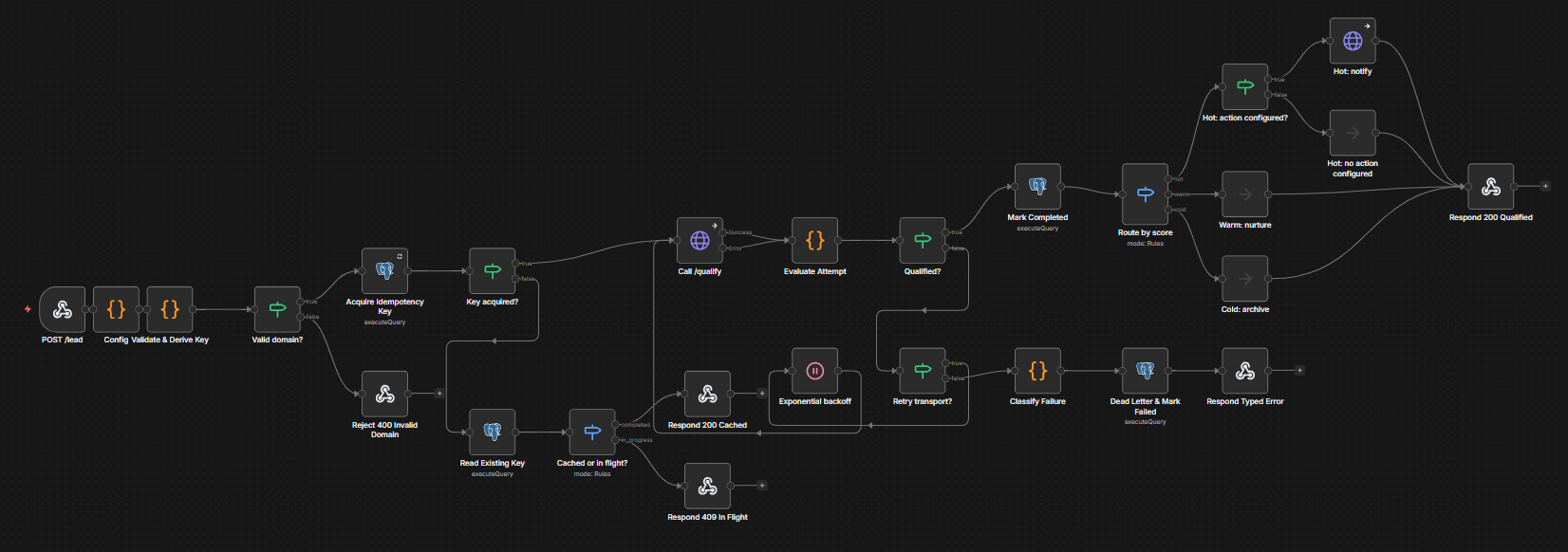
/qualify call and hand-built retry loop through the middle, tier routing and dead-lettering on the right.What was deliberately not built
- Synchronous, not async. One LLM call fits inside the webhook budget; a
202 + pollpattern would be over-engineering. The escape hatch is documented for when volume needs it. - Two providers, not a plugin zoo. Enough to prove the abstraction carries a second vendor with a different transport and cost story — no more.
- Free enrichment only (DNS, RDAP, scrape, tech fingerprint), best-effort per source, so the whole thing runs with no keys but the model provider's.
Clone and run
The stack is a self-contained docker compose up — Postgres (schema auto-created), the API, and n8n — defaulting to a deterministic mock provider so a reviewer verifies the whole core on a clean machine with no keys. Point it at a real model with two environment variables.
Live instance: the API runs at lead-qualifier-api.franciscoaraujo.eu — the health check is open, while /qualify and /stats sit behind the shared-secret token, by design.